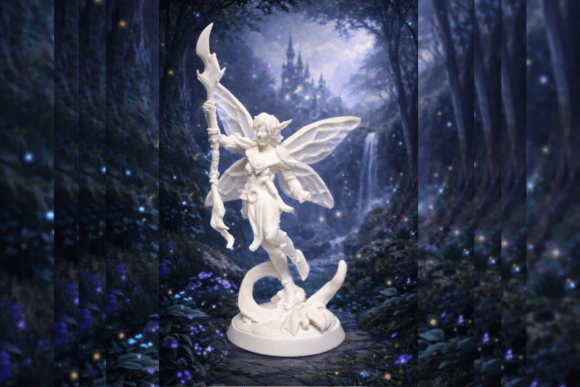
Bringing the Warrior Male Fairy 3d Print to Life: A Guide for Creators
In the evolving landscape of digital fabrication, few projects capture the imagination quite like a Warrior Male Fairy 3d Print. This specific model represents more than just a collection of polygons; it is a bridge between high-fantasy artistry and tangible reality. For hobbyists, professional prop makers, and tabletop enthusiasts, understanding the nuances of printing such a detailed figure is essential for achieving a result that honors the original design. The description of this character—a poised guardian of hidden glades, caught mid-stride with wings stretching like carved moonlight—sets a high bar for quality. To replicate this ethereal presence in physical form requires not just a capable machine, but a deep appreciation for the intricacies of resin or filament printing.
The Artistic Vision Behind the Model
The appeal of the Warrior Male Fairy 3d Print lies in its dynamic composition. Unlike static figurines that sit squarely on a flat base, this model is designed with motion in mind. The description highlights a lean, armored form balancing atop a curling, organic base that feels almost alive. This presents a unique challenge and opportunity for the maker. The "curling" nature of the base suggests complex overhangs and organic curves that test the limits of layer adhesion and support generation.
Furthermore, the character's accessories add layers of complexity. He grips an ornate staff crowned with a curved blade, an element that suggests both magic and martial skill. In the world of 3D printing, long, thin protrusions like staffs are notorious failure points. They are prone to wobbling during the print process if not adequately supported, yet excessive support can mar the smooth, pale surface that is crucial to the model's statuesque aesthetic. The goal is to preserve the sharp, elven features of the face and the subtle flow of garments without leaving unsightly scars from removal.
Technical Considerations for Success
When approaching a Warrior Male Fairy 3d Print, the choice of material and technology is paramount. While Fused Deposition Modeling (FDM) printers using PLA or PETG can handle larger versions of this model, the level of detail described—"finely detailed wings," "sculpted detail," and "smooth surface"—often demands Stereolithography (SLA) or Digital Light Processing (DLP) resin printers. These technologies excel at capturing the minute textures of armor and the delicate translucency often desired in fairy wings.
Orientation is another critical factor. To minimize visible layer lines on the face and torso, the model might need to be printed at an angle. However, this increases the surface area requiring supports. The instruction to REMOVE SUPPORTS WITH GENTLE CARE, ESPECIALLY AROUND THE STAFF AREA is not merely a suggestion; it is a directive born from experience. The staff, being a slender connection point between the hand and the ground (or base), acts as a lever. If the supports here are too aggressive, removing them can snap the staff or gouge the hand. If they are too weak, the print may fail mid-process.
- Support Density: Use lighter support settings for the wings and garment folds to prevent surface damage.
- Interface Layers: Increase the number of interface layers between the support and the model on the staff to ensure stability without fusion.
- Base Adhesion: Ensure the organic base has sufficient contact points with the build plate to prevent detachment during the long print time.
Applications Across Different Industries
The utility of a Warrior Male Fairy 3d Print extends far beyond a simple shelf decoration. Its versatility makes it a valuable asset for various professionals and creators.
- Tabletop Gaming: For Dungeon Masters and players of role-playing games, this figure serves as an impressive centerpiece. The "sentinel" vibe fits perfectly for NPCs guarding ancient ruins or mystical forests. The high level of detail reduces the need for extensive modification before painting.
- Concept Art and Prototyping: Character designers can use physical prints to study lighting, silhouette, and proportion in three-dimensional space. Holding the figure allows for a better understanding of how the "curved blade" interacts with the "lean, armored form" under real-world lighting conditions.
- Collectibles and Display: Collectors of fantasy art appreciate the "ethereal presence" described in the model. When painted with care, highlighting the "carved moonlight" effect on the wings, these prints become museum-quality pieces.
- Educational Demonstrations: Educators teaching digital sculpting or additive manufacturing can use this model to demonstrate complex support strategies and the importance of post-processing.
Navigating Limitations and Expectations
While the potential is vast, it is important to maintain realistic expectations. A raw Warrior Male Fairy 3d Print straight off the printer rarely looks like the promotional renders. The "smooth, pale surface" mentioned in the design brief is the result of significant post-processing. Supports leave marks; layer lines may be visible depending on the resolution; and resin prints require thorough washing and curing to ensure durability and safety.
One common limitation is the fragility of the wings. Described as stretching wide, they present a large surface area with minimal thickness. During the cleaning process, particularly when removing supports, there is a risk of breakage. Makers should consider printing the wings separately and assembling them later if the scale allows, or reinforcing them internally if the design permits. Additionally, the "organic base" may require leveling to sit flat on a table unless it is intended to be part of a larger diorama.
Post-Processing: Revealing the Sentinel
The transformation from a printed object to a "quietly watching" sentinel happens in the post-processing phase. This is where the instruction to remove supports with gentle care becomes most relevant. Using flush cutters for bulk removal followed by fine-grit sandpaper or specialized solvent smoothing can help blend the support marks into the surrounding geometry. Special attention must be paid to the staff area; rushing this step can ruin hours of printing time.
Painting offers the final layer of customization. The "sharp, elven features" benefit from wash techniques that settle into the crevices, enhancing depth. Dry brushing can highlight the "armored form," giving it a metallic sheen that contrasts with the matte finish of the skin or garments. For the wings, translucent paints or even embedding LED lights (if the model is hollowed appropriately) can replicate the "carved moonlight" effect, bringing the magical aspect of the warrior to life.
Evaluating Suitability for Your Project
Before committing to a Warrior Male Fairy 3d Print, evaluate your current capabilities. Do you have a printer with sufficient resolution to capture the facial details? Do you possess the patience for intricate support removal? If the answer is yes, the reward is a stunning piece of art that feels "less like an object and more like a sentinel." If you are new to high-detail printing, this model serves as an excellent benchmark for growth, pushing you to refine your orientation, support, and finishing techniques.
In conclusion, the Warrior Male Fairy 3d Print is a testament to what modern fabrication can achieve when art and engineering converge. It challenges the maker to respect the delicacy of the design while ensuring structural integrity. Whether used for gaming, display, or artistic study, this model offers a rich, engaging experience. By approaching the print with care, adhering to best practices for support removal, and investing time in finishing, creators can produce a guardian that truly seems ready to step out of the glade and into our world.